From Buyer Skepticism to Scaled Purchases
Research peptides are a category where every supplier makes the same claim. We built the creative around the one thing buyers could actually check.
02 · Executive Summary
The ad was the last step, not the first one.
Ten proof-first concepts were developed from market research, competitor analysis, and buyer-objection mapping before any design work began; the account then used purchase data to decide which earned budget.
Visible Sample · 8 Ad Rows
Across the visible sample, eight ad rows produced 259 purchases and $333,000 in Meta-reported purchase value on $13,162.90 in spend — a blended $50.82 cost per purchase at 25.30 ROAS, with all eight rows returning well above 3.0.
Reporting period: last 30 days, May 7–June 5, 2026, account “goodscience bio.” Figures are platform-attributed. The sample covers only the ad rows visible in the supplied Ads Manager screenshot — not a full-account export.
03 · The Category Challenge
Everyone claims purity. Nobody can check it.
Research peptide advertising is crowded with vague purity language, generic certificates of analysis, and untraceable sourcing — creative looks interchangeable because the claims are interchangeable. Meta also reviews the category heavily: vials, dosage language, and anything implying human use push an ad toward restriction before it reaches an audience.
“The buyer does not need another product claim. They need a reason to trust the supplier, and a way to verify it before ordering.”
What the category keeps saying
None of it is checkable at the point of the ad.
What the buyer is actually asking
- VerificationIs the documentation real, and can I see it before I order?
- Lot matchDoes the COA correspond to the batch I would actually receive?
- TestingWhat does “lab tested” mean here, specifically?
- SourcingWhere were these materials produced, and by whom?
- AccountabilityIf the material is wrong, does the supplier stand behind it?
04 · Research Inputs
Eight inputs went in before one layout came out.
No design work started until the category, competition, objections, and policy surface had been mapped — that mapping is what made the concepts different from each other rather than variations of one idea.
Market Analysis
What the category repeatedly claims and which promises have gone generic through repetition.
Competitor Review
Offer framing, vial presentation, COA usage, guarantee positioning, CTA structure, visual sameness.
Buyer Objections
The specific hesitations behind a non-purchase, expressed as questions the buyer would ask.
Category Patterns
Which visual conventions dominate the feed and which carry policy exposure.
Offer Analysis
What is actually being sold: research-grade lyophilized peptides for qualified laboratory and in-vitro testing.
Proof Inventory
Lot-specific COAs, third-party testing, HPLC and mass spectrometry, U.S. production, 200% guarantee, fast domestic shipping.
Compliance Constraints
The restricted claim and visual set for the category, established before concepting rather than after rejection.
Landing-Page Context
What the destination can substantiate, so the ad and page make the same argument.
Creative is engineered before it is designed. The design program opens last.
Concepts built from separate objections can be tested against each other. Concepts built from one idea can only be tested for execution.
05 · Strategic Thesis
Verify first. Order with confidence.
Most qualified buyers aren’t hesitating for lack of interest — they hesitate because the category makes proof hard to trust, which reframes the ad’s job from persuading to making verification easy.
Master Thesis · Batch 01
The peptide market feels crowded with vague claims, questionable sourcing, generic COAs, and suppliers that make proof hard to verify. Good Science Bio should feel like the serious supplier that helps buyers verify before they order.
Research peptides with proof, not hype.
What the brand can actually substantiate
- DocumentedLot-specific COAs — every purity claim ties to a real lot.
- TestedHPLC + mass spectrometry, third-party analytical verification.
- DomesticU.S.-made, no overseas relabeling or mystery sourcing.
- Accountable200% purity guarantee — a standard the buyer can hold them to.
- OperationalFast U.S. shipping with documentation included.
- DisciplinedResearch-use-only framing across every asset.
Priority Hierarchy
06 · The Creative Operating System
Ten stages stand between a buyer objection and an ad.
Every concept in the batch moved through the same ten-stage pipeline, with research and compliance sitting inside the creative process rather than beside it.
Market Research
Category claims, formats, fatigue.
Competitive Analysis
Offers, proof usage, visual sameness.
Buyer Insight
The one hesitation behind the concept.
Big Idea
The tension turned into a position.
Strategic Angle
A scalable direct-response line of attack.
Visual Direction
Hero layout, hierarchy, proof chips, guardrails.
Copy + CTA
On-image headline, support, primary text, action.
Compliance Review
Design risk, restricted patterns, review rationale.
Production
A finished 4:5 feed-first static.
Performance Loop
Purchases, cost, value, and ROAS decide what scales.
Stage 10 does not end the pipeline. It rewrites stage 03 for the next batch. Compliance sits at stage 08 — before production and after copy — because reviewing a finished asset is expensive; reviewing a specification is not.
07 · Compliance System
These ads sell verification standards, not peptide effects.
The restricted set was written before concepting; every concept was built to live inside documentation, supplier standards, and research procurement rather than product use or outcomes.
Built around
- +Supplier standards
- +Documentation
- +COA access
- +Lot-level verification
- +Third-party testing
- +U.S.-made sourcing
- +Fulfillment
- +Research-use-only positioning
Deliberately avoided
- −Human-use implications
- −Animal-use implications
- −Medical claims
- −Therapeutic claims
- −Safety or efficacy claims
- −Dosage language
- −Injection visuals
- −Reconstitution instructions
- −Human bodies
- −Before/after imagery
- −Doctor/patient imagery
- −Wellness/fitness/beauty outcomes
- −Claims tied to personal health conditions
- −Competitor attacks
- −Misleading or unverifiable proof visuals
Every concept sells one of: documentation, verification, traceability, supplier standards, research-use-only discipline, fulfillment reliability, or buyer confidence before purchase. None of them sells an effect.
A mandatory legal band appears on every export stating products are sold strictly for laboratory research and in-vitro testing, not intended for human or animal consumption — it supports a compliant ad; it is not used to rescue an unsafe one.
08 · The Creative Portfolio
Ten proof-first angles, one campaign system.
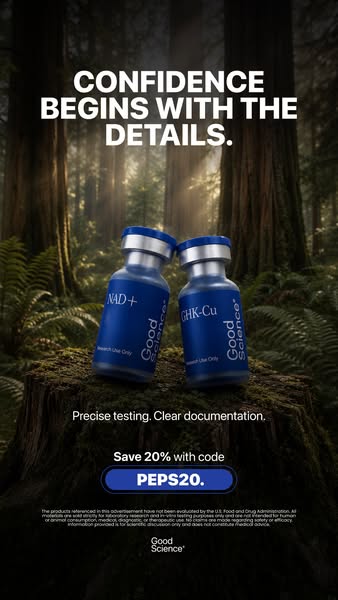
Each concept shipped with a buyer insight, big idea, strategic angle, hero layout, on-image headline and support chips, Meta primary text, CTA, design-risk rating, compliance note, and written Meta review rationale — all rendered as finished 4:5 statics.
COA-First Verification
“Check the COA First”
Can I verify this supplier before I buy?
Risk Reversal
“200% Purity Guarantee”
Will the purity claim match reality?
Domestic Sourcing
“No Mystery Sourcing”
Where did this actually come from?
Lot-Specific Verification
“The Lot Number Test”
Does the COA match this batch?
Testing Specificity
“HPLC + MS Proof Stack”
What does “lab tested” mean here?
Fulfillment + Trust
“Fast, Documented, Domestic”
Will the paperwork arrive with it?
Anti-Hype Positioning
“Proof Over Hype”
Why trust this supplier over another?
Educational Direct Response
“Research Buyer’s Checklist”
How do I judge a supplier at all?
Supplier Upgrade
“Upgrade from Guesswork”
Should I switch from my current one?
Traceability
“Chain of Custody”
What happened before it reached me?
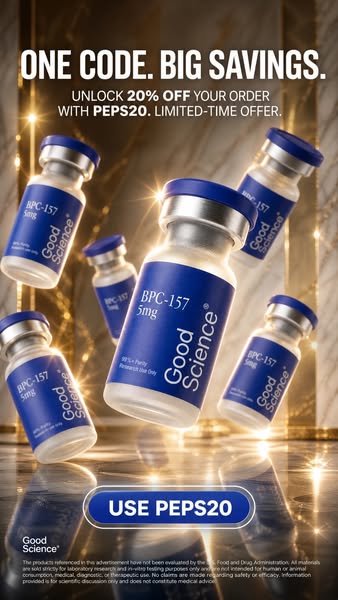
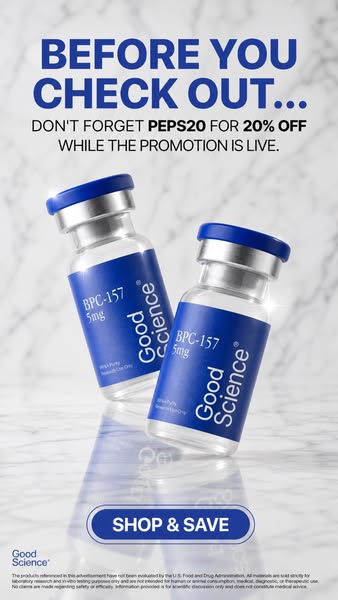
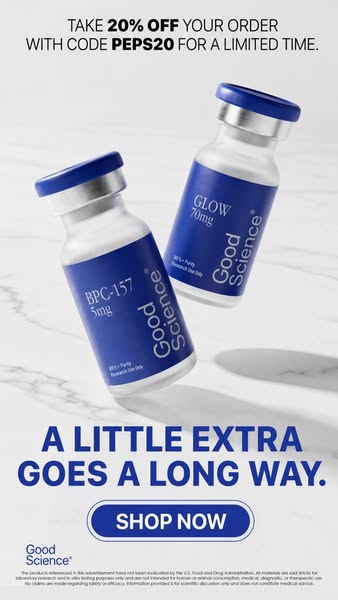
Production order for Batch 01 was GSB-C01, GSB-C08, GSB-C07, shown separately from the account performance rows.
09 · Concept Deep Dive · GSB-C04
The Lot Number Test
A generic COA doesn’t feel trustworthy — buyers want documentation tied to the actual batch in front of them. A purity claim only matters when it connects to a real lot; the documentation must match the batch.
Hero Layout
Macro COA with the “Lot #” field highlighted, a blue “Lot Verified” callout, the vial as a secondary object with its label rotated away. No peptide name, no dosage, no mg — the document stays the hero.
On-Image Headline
“A COA Without a Lot Number Is Just a Claim.”
Support Chips
Check the lot · Check the test date · Check the documentation
CTA
Verify Before You Order
Meta Primary Text
“COA available” is not enough for serious buyers. Good Science Bio is built around lot-specific documentation, third-party testing, and verification before purchase.
Meta Compliance Review Rationale
The headline challenges generic proof claims without referencing human health, safety, efficacy, or use. The viewer is asked to verify a lot number and a test date, which is a procurement and documentation action rather than a product-use action. Making the document the hero, and keeping the vial secondary and free of compound names or mg amounts, is what makes the ad defensible as supplier-transparency content.
Concept 04 of 10, Good Science Bio Creative Brief.
10 · Scaled Winner Spotlight · AD6
When strategic creative meets scaled purchase volume.
As Delivered
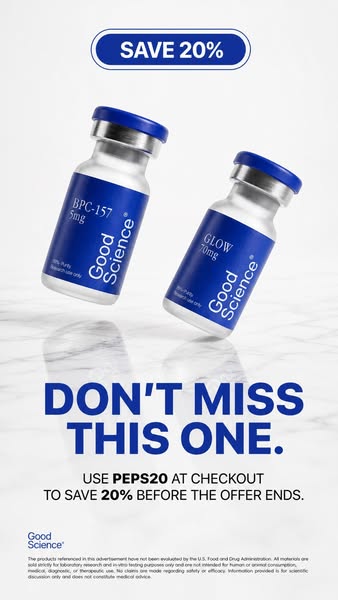
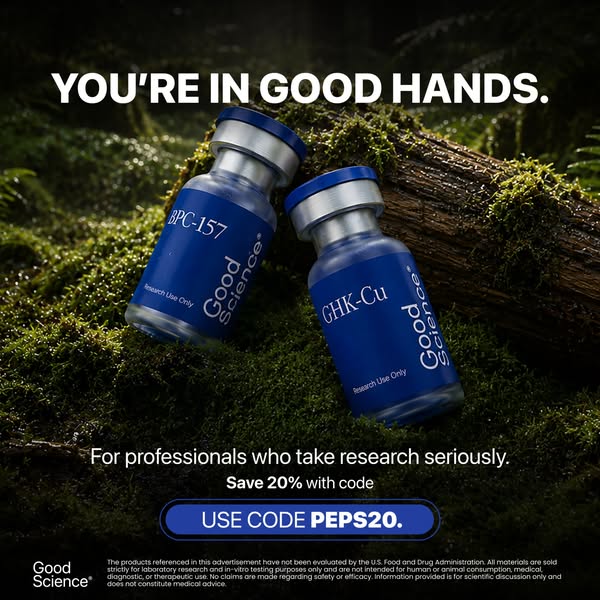
The desert / vial “Expanded Research Access” static, plus renders in the Facebook and Instagram feed (with a mocked BOGO caption: “BOGO is live. Buy one. Get one free…”).
Meta Ads Manager · May 7–Jun 5, 2026 · $8,664.03 spend
Visual interruption at feed scale
The desert reads as scale and openness rather than a lab, which is what makes it stop a scroll full of near-identical vial-on-white creative.
The offer is the headline
“Expanded Research Access” states a commercial reason to engage without touching a product-effect claim, and the BOGO carries the incentive.
Product legible at thumbnail size
One object, centered, high contrast against the environment.
Creative observations are strategic interpretation, not proven causation. Ads Manager attributes results to the ad, not to any individual creative element within it.
11 · Performance Leaderboard
Read it as a portfolio, not a ranking.
Ordered by spend as the export itself is sorted; maturity classification is the agency’s own reading of volume against spend.
ROAS by Ad Row · 20x Threshold
Neon bars cleared 20x ROAS · six of eight rows
| # | Ad | Role / Interpretation | Pur. | CPP | Spend | Value | ROAS |
|---|---|---|---|---|---|---|---|
| 01 | AD6 | Research access/offer — Scaled Winner | 161 | $53.81 | $8,664.03 | $212,000 | 24.47 |
| 02 | AD1 | COA-first verification — Volume Contributor | 49 | $48.01 | $2,352.39 | $58,500 | 24.87 |
| 03 | AD3 | Domestic sourcing — Validated | 14 | $50.52 | $707.20 | $14,800 | 20.93 |
| 04 | AD2 | Purity guarantee — Validated | 7 | $82.14 | $574.97 | $10,350 | 18.00 |
| 05 | AD5 | HPLC + MS proof stack — Efficient Performer | 15 | $27.21 | $408.17 | $20,200 | 49.49 |
| 06 | AD1 | Second AD1 row, separate creative — Emerging | 4 | $63.03 | $252.11 | $6,800 | 26.97 |
| 07 | AD3 | Second AD3 row, separate creative — Emerging Signal | 8 | $12.95 | $103.62 | $9,200 | 88.79 |
| 08 | AD5 | Second AD5 row, separate creative — Early Test | 1 | $100.41 | $100.41 | $1,150 | 11.45 |
Row 07’s 88.79 ROAS on $103.62 is a useful signal for the next creative round, not proof of scale — AD6 remains the mature result because it held cost while absorbing 66% of the visible spend. Three ad names (AD1, AD3, AD5) each appear twice with visibly different creative in the export and are never merged; roles are strategic interpretation, not platform labels.
12 · Source Evidence
Eight rows, one export, no reconstruction.
The leaderboard is a direct redraw of the supplied Meta Ads Manager screenshot — account “goodscience bio,” last 30 days May 7–Jun 5, 2026, results from 171 ads — nothing aggregated, estimated, or filled in.
The repeated names (AD1, AD3, AD5) stay separate because the thumbnail against each row shows different creative, so combining them would overstate the maturity of the smaller rows.
The visible sample covers eight rows of an account reporting 171 total ads; deck totals are visible-row totals only, never presented as full-account spend or revenue. No CRM revenue, net profit, lifetime value, or acquisition-cost data was supplied or is claimed.
13 · Strategic Interpretation
The finished ad is only the last step.
The strategy answered a real objection
Verification, not desire, was the barrier; every concept converts a specific doubt into a specific action — check, review, verify, view, follow the proof path.
Compliance and conversion were solved together
Staying inside documentation and supplier standards wasn’t a constraint on the selling idea — in this category it was the selling idea.
Multiple angles removed single-message risk
Ten objections meant ten independent chances to find message-market fit rather than ten executions of one guess.
Media buying decided what earned scale
Purchase count, cost, value, and ROAS separated the mature result from the directional ones, and the mature result took the budget.
In a category where every supplier says the same thing, the differentiator is what the buyer can independently check.
The Compounding Effect
- Research produced the angle.
- Compliance produced the lane.
- Creative produced the click.
- Performance data produced the next brief.
14 · Recommended Next Scaling Cycle
Turn the strongest angles into creative families.
The next move isn’t a batch of unrelated ads — it’s building repeatable families around what earned spend while protecting the proven rows from exploratory budget.
Creative
- Expand AD6 into a family — new environments around “Expanded Research Access,” holding the offer constant while the setting varies.
- Produce more offer-led variants — BOGO and access framings without touching a product-effect claim.
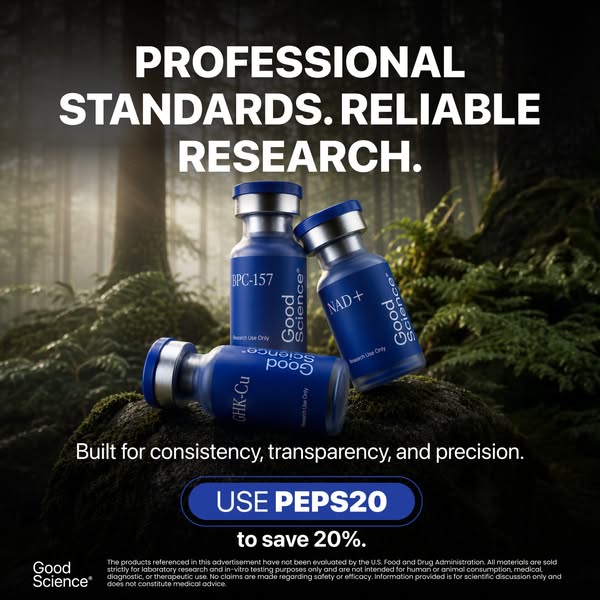
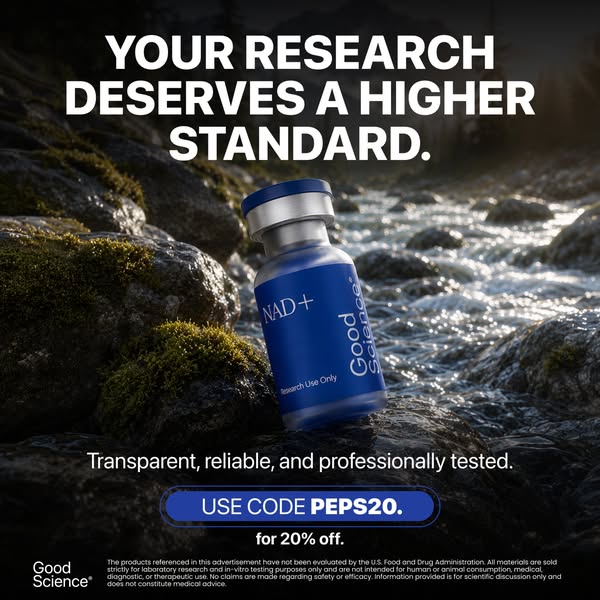
- Build variations of the proof concepts that earned budget — COA-first, domestic sourcing, HPLC + MS stack.
- Adapt lot verification into motion — the document-as-hero system translates to short-form video.
- Run headline and CTA tests against the winning visual systems rather than replacing them.
Media & Measurement
- Separate scaled winners from exploratory tests — protect mature rows, give new concepts enough budget for directional data.
- Maintain a structured testing budget so creative supply never depends on one performing ad.
- Read low-spend signals as signals, not scaling decisions — an 88.79 ROAS on $103.62 justifies more budget, not a scaling decision.
- Connect ad / ad set / campaign identifiers to CRM when available to test order quality, AOV, and repeat rate.
- Keep compliance guardrails intact — don’t chase performance by adding claims, dosage, human-use, or medical visuals.
Turn proven proof mechanisms into repeatable creative families with fresh executions. Preserve winners, expand them, and judge scale on mature purchase economics.
15 · Conclusion & Capability
Research created the strategy. Creative earned attention. Performance data determined what scaled.
Creative Strategy & Production
Market research, buyer-objection mapping, positioning, high-end static / video / AI-assisted creative systems.
Meta Strategy & Media Buying
Campaign architecture, testing design, budget reallocation, winner scaling for direct-response accounts.
Compliance Consulting
Creative, claim, and funnel review to reduce policy risk before spend is scaled.
High-Scrutiny Categories
Research supply, peptides, telehealth, supplements, and other closely reviewed verticals.
Research peptides with proof, not hype.
Confidential · Prepared for client review