
How MAVN Helped YoungLA Scale From $30 Million to $195 Million in Revenue Through Google Ads Management
Since 2022, MAVN has helped YoungLA scale from approximately $30 million in annual revenue to $195 million — including the company's first $100 million revenue year — through strategic Google Ads management.
02 · Executive Summary
Not a media buy. A Google Ads program built to scale with the brand.
YoungLA entered the engagement as an already successful apparel brand with a loyal customer base, strong products, and significant growth potential. The challenge was no longer proving the brand could generate demand — it was building a Google Ads program capable of capturing that demand efficiently, supporting increasingly aggressive growth targets, and continuing to perform as the company expanded.
The Engagement
The engagement required more than routine campaign management — a disciplined performance system connecting search demand, product-level economics, shopping visibility, customer intent, promotional calendars, inventory, brand growth, budget allocation, conversion data, and long-term revenue objectives.

03 · The Client
A fast-growing lifestyle and athletic apparel brand.
YoungLA is known for its strong community, creator-driven brand presence, frequent product launches, and highly engaged customer base. As the company grew, Google became an increasingly important part of the customer journey.
Customers were discovering products through creators, social media, organic content, and word of mouth — then turning to Google to search for the company, compare products, revisit launches, and complete purchases. This created a major opportunity, and a complicated measurement and management challenge.
Google Ads needed to capture existing brand demand without becoming dependent on it — while introducing new customers, supporting a growing catalog, and allocating budget according to actual commercial opportunity.
What the brand already had
- +Loyal customer base
- +Strong, differentiated products
- +Creator-driven brand presence
- +Frequent product launches
- +Highly engaged community
- +Organic demand from social
- +Significant growth potential
The demand existed. The job was to build the system that could capture, convert, and expand it at scale.
04 · The Starting Point
A $30M account and a $200M account are not the same job.
At $30M, Google Ads can often be managed with relatively broad structures and straightforward optimization. At nearly $200M, the requirements are completely different — YoungLA needed a strategy capable of evolving with the business.
05 · The Core Challenge
Scaling without losing efficiency.
Rapid growth can disguise weaknesses inside a paid media account. When brand awareness rises, branded searches rise naturally and revenue may increase even when the underlying structure is not becoming more efficient — making the account appear stronger than it actually is. The objective was therefore not just to report more Google Ads revenue.
Where incremental growth was coming from
Which products deserved more investment
Which campaigns were capturing demand versus creating it
How much budget could be added responsibly
Where the account was overly dependent on branded traffic
How Google Ads should support launches and promotions
How to protect profitability while continuing to scale

06 · The Objective
Five goals the Google Ads program was built around.
The engagement was designed around five major goals — each tied to a specific commercial function the account needed to perform.
Capture High-Intent Demand
When customers searched for YoungLA, specific products, collections, or relevant apparel categories, the brand needed to be visible with the right message and product.
Expand Beyond Existing Brand Demand
Reach customers who were actively shopping but had not yet decided to purchase from YoungLA.
Support Product Launches and Promotional Moments
Respond quickly to new launches, restocks, seasonal collections, major promotions, creator collaborations, and high-demand categories.
Allocate Budget According to Business Value
Account for margin, inventory, conversion rate, average order value, new-customer potential, repeat behavior, promotional timing, and incremental opportunity.
Build a System That Could Continue Growing
Architecture able to support YoungLA at $30M, $100M, and the next stage of the company’s growth.
07 · Phase One · Understanding the Customer Journey
Google appeared toward the end of the journey — and that shaped everything.
YoungLA customers did not interact with the company through only one channel. A typical customer moved through a multi-step path before purchasing.
A Typical Customer Journey
Google often appeared toward the end — highly valuable, but it meant the account needed to distinguish between demand Google captured and demand Google helped expand. That distinction shaped campaign structure, reporting, bidding, and budget allocation.
08 · Phase Two · Separating Brand and Nonbrand Demand
A clear distinction between branded and nonbranded traffic.
Branded performance was not treated as the sole indicator of account health. Branded campaigns protected visibility and supported launches; nonbranded campaigns represented the more incremental form of growth.
Branded Search · Protected
Campaigns ensured YoungLA controlled the customer experience when shoppers searched for:
- +YoungLA
- +YoungLA clothing
- +YoungLA drops
- +YoungLA products
- +Specific YoungLA collections
- +Individual YoungLA product names
Nonbranded Search · Expanded
Used to reach customers searching by category, use case, style, or product type — a more incremental, more competitive form of growth that required discipline across:
09 · Phase Three · Product-Level Campaign Management
The catalog could not be treated as one undifferentiated group.
Different products had different demand levels, margins, conversion rates, inventory positions, price points, launch cycles, customer profiles, and repeat purchase patterns. Investment was prioritized accordingly.
Hero Products
High-demand products capable of generating meaningful volume received greater visibility and budget support.
New Releases
Launch campaigns were structured to capture immediate interest around new products and collections.
Evergreen Products
Consistent sellers provided a stable base of revenue beyond individual launch periods.
High-Margin Products
Products with stronger unit economics could support more aggressive acquisition targets.
Limited-Inventory Products
Budgets remained aligned with available inventory to prevent wasted demand.
Underexposed Products
Products with strong economics but limited advertising exposure represented opportunities for expansion.
10 · Phase Four · Shopping and Product Feed Strategy
The feed gives Google the information required to match products to the right searches.
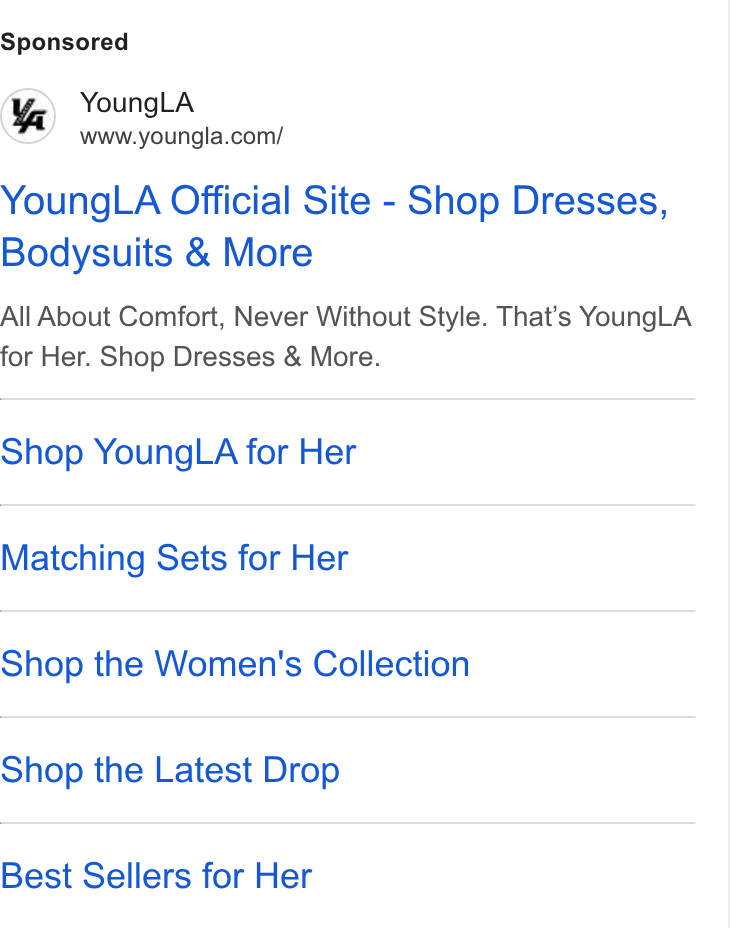
For an ecommerce apparel company, the product feed is one of the most important components of Google Ads performance. The goal was not simply to make products eligible for Shopping placements — it was to match products with the most commercially relevant searches.
Key Feed Considerations
Product Segmentation
Products could be grouped according to:
This made it possible to apply different budgets and performance expectations to different groups of products.
11 · Phase Five · Campaign Architecture Built for Scale
Each campaign had a specific role rather than competing for the same traffic.
As YoungLA grew, the account required enough structure to support decision-making without becoming unnecessarily fragmented. Campaigns were organized around distinct commercial functions.
Brand Protection and Demand Capture
Captured high-intent customers already searching for YoungLA.
New Customer Acquisition
Focused on reaching shoppers who had not yet committed to the brand.
Product and Category Campaigns
Gave priority to strategic products and product groups.
Launch Support
Adjusted around new releases, restocks, and major demand spikes.
Remarketing
Delivered more relevant follow-up messaging to site and product viewers.
Promotional Campaigns
Adjusted to reflect the active offer, customer urgency, and inventory position.

12 · Phase Six · Budget Allocation
At scale, the question is not how much to spend — it is where the next dollar should go.
The strategy avoided treating every campaign as equally deserving of incremental budget. Investment moved toward the areas with the strongest combination of customer demand and commercial opportunity.
13 · Phase Seven · Supporting Product Drops
Every launch was a revenue opportunity and a source of future performance data.
YoungLA's launch model created intense, concentrated periods of demand. Google Ads needed to respond rapidly — before, during, and after.
Before a Launch
- +Search behavior
- +Product availability
- +Customer interest
- +Website traffic
- +Conversion volume
- +Branded search volume
During a Launch
- +Which products were gaining traction
- +Which products were selling out
- +Where demand was exceeding supply
- +Which searches were emerging
- +Whether budgets were limiting growth
- +Whether traffic was being sent to the right pages
After a Launch
- +Which products had lasting demand
- +Which products were primarily launch-driven
- +Which collections should receive continued advertising
- +Which search terms revealed new customer intent
14 · Phase Eight · Search Term and Intent Analysis
Direct insight into what customers were actively looking for.
Irrelevant searches were excluded. High-value searches were given greater strategic importance. New patterns were used to refine campaign structure, product titles, ad messaging, and landing pages.
High-intent product searches
Emerging categories
Competitor comparisons
Branded variations
Product naming patterns
Irrelevant traffic
New landing-page opportunities
Customer language that could inform broader marketing
15 · Phase Nine · Landing-Page Alignment
The advertisement was only the beginning of the conversion process.
A customer searching for a particular product or category needed to arrive on a page that matched the original intent. Sending every customer to the homepage would sacrifice valuable intent.

16 · Phase Ten · Measurement and Decision-Making
Determining which numbers should drive decisions.
No metric was interpreted in isolation. A campaign with a lower reported return could still be strategically valuable if it reached more new customers; a branded campaign could report extremely strong performance while primarily capturing demand created elsewhere. The strategy required understanding both.
17 · Phase Eleven · Continuous Optimization
Google Ads management was not a one-time account rebuild.
The program required continuous adjustment as YoungLA evolved. The account changed as the business changed — and that adaptability was essential to sustaining year-over-year growth.
18 · The Results
$30 million to $195 million. A 6.5x increase. Consistent growth since 2022.
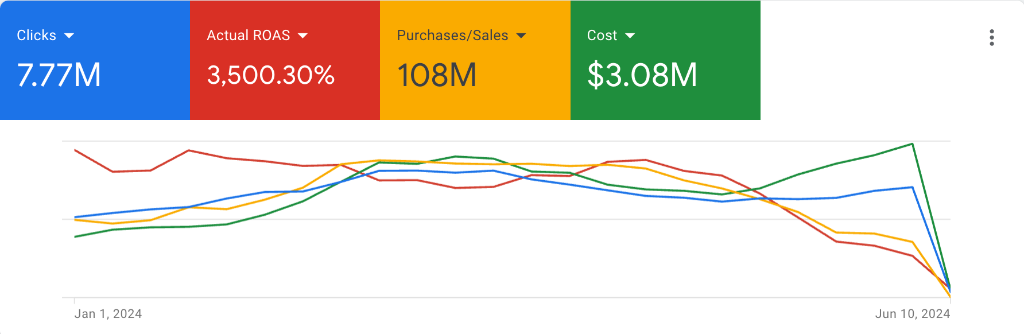
Google Ads did not scale YoungLA on its own. The growth was driven by MAVN's strategy, management, and decision-making — applied to a brand with strong products, creators, organic demand, and a broader marketing ecosystem. Google Ads was the channel; MAVN was the operator behind it.
Client Testimonial
"Helped us reach our first $100M/year and has delivered consistent year-over-year growth since 2022. The strategies are next level."
Gumer Chopra
CEO, YoungLA
19 · Why the Strategy Worked
Seven reasons the program held at scale.
Google Ads was managed as part of the business
Campaign decisions were connected to product launches, inventory, customer intent, revenue goals, and company growth.
Brand demand was not confused with incremental growth
Branded campaigns remained important, but performance was evaluated in the context of how demand was created and captured.
Products were managed according to their commercial role
Budgets were aligned with product demand, inventory, economics, and strategic importance.
The account evolved with the company
A structure suitable for a $30M business would not be sufficient approaching $200M. The strategy matured as YoungLA grew.
Google Ads supported the full launch calendar
Campaigns were not operated in isolation from product drops, restocks, promotions, or seasonal demand.
Decisions were based on marginal opportunity
The focus was not simply on historical return but where additional investment could generate the greatest next level of growth.
Optimization never stopped
Search demand, products, competitors, inventory, and customer behavior changed continuously. The management process changed with them.
20 · Conclusion
MAVN built and operated the Google Ads growth system that helped YoungLA scale — connected to product, inventory, customer behavior, launches, and the long-term direction of the business.
The most important result was not a single campaign or promotional period — it was the operating system MAVN built around YoungLA's Google Ads account, capable of supporting a much larger company. As YoungLA moved from $30M toward $195M, the strategy grew more complex, and MAVN designed it to perform all of those functions together.
The Closing Call to Action
$30M to $195M. A Google Ads program MAVN built to scale with the brand.
MAVN builds and operates Google Ads programs connected to product launches, inventory, search demand, customer intent, and long-term growth objectives — designed to perform as the business scales.
$30M to $195M. 6.5x revenue growth. Consistent since 2022.
Confidential · Prepared for client review