How MAVN Generated $5.74 Million in Monthly Sales for a Premium Beauty Brand Through Google Ads
A premium beauty and personal care brand turned Google Ads into a scalable ecommerce revenue engine — $5.74 million in tracked sales from $573,000 in spend across 31 days, at a 10x+ return.
02 · Executive Summary
Not a media buy. A Google Ads program built to scale with the brand.
A rapidly growing premium beauty and personal care brand came to MAVN with a clear objective: turn Google Ads into a scalable, dependable revenue channel capable of supporting millions of dollars in monthly ecommerce sales.
The brand already had meaningful customer demand. The challenge was capturing that demand efficiently, expanding beyond customers already familiar with the brand, and allocating more than half a million dollars in monthly media spend without allowing profitability to deteriorate.
The Engagement
MAVN restructured the account around customer intent, product-level economics, inventory, campaign purpose, branded and nonbranded demand, Shopping performance, and measurable revenue — building a system capable of operating at meaningful scale while maintaining more than ten dollars in revenue for every dollar invested.

03 · The Client
An established direct-to-consumer beauty brand.
The client sold a broad range of premium skincare, haircare, and everyday beauty products directly to consumers. Its catalog included established bestsellers, replenishable products, product bundles, and seasonal releases.
Customers discovered products through social media, creators, recommendations, email, organic content, and word of mouth before searching for the company on Google. That created a major opportunity — and a complicated measurement and management challenge.
Different products carried different margins, conversion rates, inventory levels, and repeat-purchase patterns. The account could not be managed effectively as one large, undifferentiated catalog.
Catalog Across Categories
What the brand already had
- +Strong product demand
- +A broad ecommerce catalog
- +Repeat-purchase behavior
- +High-intent branded searches
- +Customers actively comparing products
- +Frequent product replenishment
- +Promotional and seasonal sales periods
- +A large amount of purchase-ready search traffic
04 · The Starting Point
Google Ads was producing revenue — but it needed a disciplined operating system before it could scale.
Several issues had to be addressed before the channel could be scaled reliably.
Product Performance Was Uneven
A small group of products generated a disproportionate share of revenue while weaker products kept receiving exposure without the same commercial return.
Branded Demand Could Distort Performance
Customers often discovered products through social, creators, and word of mouth before searching the brand on Google — branded search could look exceptional while capturing demand created elsewhere.
The Account Needed to Reach New Customers
The brand had to capture branded searches while also reaching shoppers browsing beauty categories who had not yet chosen the client.
Scaling Introduced Greater Financial Risk
At $573,000 in monthly spend, a five-percent allocation mistake represents tens of thousands of dollars — the account required close control across budgets, segmentation, and tracking.
Products Needed a Clearer Distinction Between
05 · The Objective
Five priorities the Google Ads program was built around.
The goal was not simply to increase spend. It was to build a program capable of producing substantial revenue while remaining responsive to the economics of the business.
Capture High-Intent Customer Demand
Customers actively searching for the company, its products, or closely related categories needed to reach the most relevant page with the right offer.
Expand Beyond Branded Searches
Attract new customers shopping in the category who had not yet decided to purchase from the client.
Prioritize Commercially Valuable Products
Advertising investment needed to follow actual product opportunity rather than being distributed evenly across the catalog.
Reduce Unproductive Spend
Irrelevant searches, low-value products, campaign overlap, and poor landing-page alignment needed to be caught before consuming significant capital.
Build a System That Could Scale
A durable Google Ads structure capable of supporting increasing revenue targets, larger budgets, new products, and changing demand.
06 · Phase One · Establishing a Reliable Measurement Foundation
Before aggressive optimization, the data had to be trustworthy enough to guide decisions.
The performance system needed to provide a reliable view of revenue, cost, conversion value, and product- and campaign-level performance. Without accurate measurement, automated bidding can optimize toward incomplete or misleading outcomes.
07 · Phase Two · Rebuilding the Account Around Customer Intent
Structured by why the customer was searching and where they were in the buying process.
Branded performance was analyzed separately from broader customer acquisition so existing demand did not obscure the true performance of nonbranded growth campaigns.
Branded Search · Captured
Campaigns helped the company control the search experience for customers already searching for:
- +The company name
- +Specific branded products
- +Product collections
- +Product bundles
- +Promotions
- +Reviews
- +Restocks
- +Brand-plus-product combinations
Nonbranded Search · Expanded
Reached customers searching by category, problem, routine, or format — a more competitive form of growth requiring precise keywords and landing-page alignment:
Shopping & Product-Based Campaigns
For a large beauty catalog, product-data quality was critical. Google needed to understand:
Remarketing
Rather than repeating the same message shown to a new customer, remarketing reflected existing awareness:
- +Previously viewed products
- +Bestsellers
- +Product bundles
- +Replenishment
- +Promotions
- +Product education
- +Returning to complete a purchase
08 · Phase Three · Product-Level Segmentation
Moving away from treating the entire catalog equally.
Products were organized according to their commercial role, allowing capital to be allocated by actual business value.
Hero Products
High-demand products capable of generating substantial revenue and supporting increased advertising investment.
Replenishable Products
Strong repeat-purchase behavior justified a different acquisition strategy from one-time or seasonal purchases.
High-Margin Products
Stronger unit economics supported more aggressive customer-acquisition targets.
Product Bundles
Increased average order value and introduced customers to multiple products in one purchase.
New Releases
Controlled testing before receiving significant investment.
Seasonal Products
Performed differently by time of year, customer routines, gifting periods, or promotional events.
Low-Inventory Products
Spend stayed aligned with inventory to avoid generating demand the company could not fulfill.
Underperforming Products
Products consistently consuming spend without acceptable revenue were reduced, excluded, or moved into separate testing environments.

09 · Phase Four · Product-Feed Optimization
For an ecommerce beauty company, the product feed functions as part of the advertisement.
Google relies on the feed to determine which products appear for which searches. MAVN improved the quality and organization of every field that influenced matching.
Feed Elements Managed
Product Titles
Depending on the product, titles communicated:
Custom Labels
Grouping products internally by these attributes gave the account more control over bidding and budget allocation.
10 · Phase Five · Search-Term Management
High impression volume alone does not create value.
Search-term analysis identified commercially relevant queries and excluded irrelevant ones. At more than half a million dollars in monthly spend, this was an ongoing process — not a one-time cleanup.
High-intent product searches
Profitable nonbranded queries
Emerging customer demand
Brand-plus-product combinations
Product comparison searches
Irrelevant informational searches
Low-intent traffic
Searches requiring dedicated landing pages
New keyword opportunities
11 · Phase Six · Landing-Page Alignment
A strong ad can still fail when the post-click experience doesn't match intent.
A customer searching for a specific skincare product should not be sent to a generic homepage. The goal was to preserve intent from the original search through the purchase.
12 · Phase Seven · Budget Allocation
Not how much the brand could spend — but where the next dollar could produce the greatest return.
Campaigns did not receive equal budget increases. Investment moved toward the products, categories, and campaign types demonstrating the strongest combination of demand and efficiency.
13 · Phase Eight · Scaling Without Losing Control
Scaling required more than raising daily budgets.
When investment increased, MAVN monitored whether the additional spend kept producing acceptable revenue. The account expanded across multiple opportunities rather than forcing more budget into a single saturated campaign.
Marginal return on additional spend
Conversion stability
Search impression share
Lost impression share from budget
Product-level efficiency
New-customer potential
Search-term quality
Campaign saturation
Landing-page conversion
Inventory constraints

14 · Phase Nine · Promotional & Seasonal Management
Beauty sales shift sharply across launches, holidays, gifting seasons, and sitewide promotions.
Google Ads needed to respond quickly — before, during, and after each event.
Before a Promotion
- +Search volume
- +Conversion rate
- +Customer urgency
- +Product demand
- +Average order value
- +Inventory movement
During a Promotion
- +Budget limitations
- +Product availability
- +Search behavior
- +Conversion volume
- +Revenue concentration
- +Campaign pacing
After a Promotion
- +Normalize bidding to baseline
- +Avoid continuing promotional conversion rates indefinitely
- +Restore standard budgets
- +Re-segment launch-driven vs. evergreen products
15 · Phase Ten · Continuous Optimization
The account was not treated as a one-time setup.
At this level of scale, Google Ads management required continuous monitoring and adjustment as customer behavior and business priorities changed.
16 · The Results
$5.74 million in tracked sales from $573,000 in spend — in 31 days.
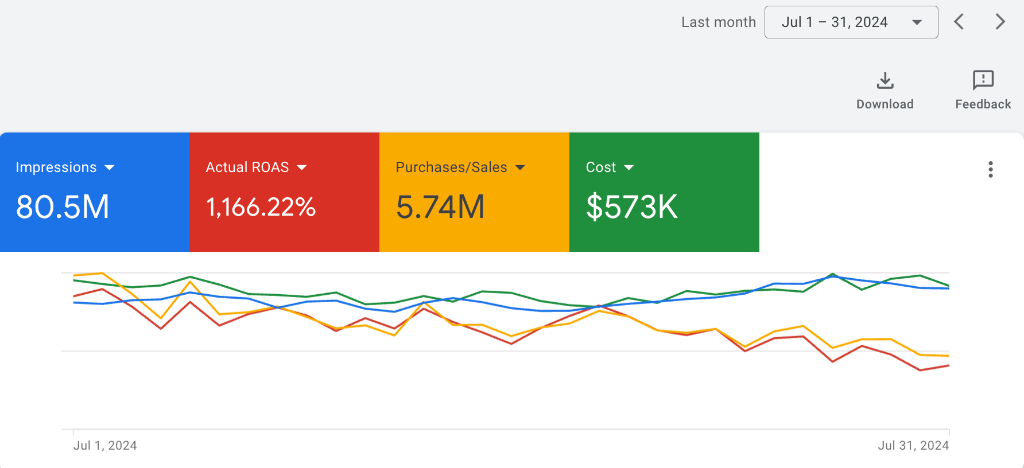
Reporting note: The dashboard displays a 1,166.22% ROAS. The rounded sales and cost totals shown on the same dashboard calculate to approximately 10.0x. We publish the conservative claim of "10x+ ROAS" unless the underlying reporting data confirms the higher figure.
Google Ads did not generate these results on its own. The growth was driven by MAVN's strategy, management, and decision-making — applied to a brand with strong products, organic demand, and a broad ecommerce catalog. Google Ads was the channel; MAVN was the operator behind it.
17 · Why the Strategy Worked
Eight reasons the program held at scale.
Google Ads was managed as part of the business
Campaign decisions were connected to product performance, inventory, promotions, customer intent, and revenue goals.
The catalog was not treated as one product
Investment was allocated according to the commercial role and performance of each product group.
Branded demand was separated from incremental growth
The account captured existing demand without relying solely on branded campaigns to demonstrate success.
Search quality was managed continuously
Irrelevant queries were addressed before they could consume a meaningful portion of the budget.
Product data supported campaign performance
The product feed was treated as a strategic advertising asset rather than a passive technical requirement.
Budget followed evidence
Additional investment moved toward campaigns capable of converting more demand without immediately sacrificing efficiency.
The entire customer journey was considered
Search intent, ads, product listings, landing pages, availability, and checkout were evaluated together.
Optimization continued after scale was achieved
The account was continually adjusted as demand, products, inventory, and customer behavior changed.
18 · The Broader Impact
The most important outcome was not one successful campaign.
It was the creation of a Google Ads operation capable of supporting millions of dollars in monthly sales — an integrated revenue engine rather than a collection of isolated campaigns.
19 · Conclusion
Generating a strong return at low spend is one challenge. Maintaining it at more than half a million dollars a month is another.
MAVN helped an anonymous premium beauty and personal care brand build a Google Ads system capable of reaching more than 80 million impressions and translating that visibility into millions of dollars in tracked sales — designed to perform as the business scales.
The Closing Call to Action
$573K invested. 80.5M impressions. $5.74M in monthly sales. A 10x+ return.
MAVN builds and operates Google Ads programs connected to product economics, inventory, search demand, customer intent, and long-term growth objectives — designed to perform as the business scales.
$5.74M in sales. $573K in spend. 10x+ ROAS. One Google Ads system built for sustained ecommerce scale.
Anonymous Client · Prepared for review